Paving
Which terrace paving stays under 60 degrees in July sun
Paving choice on a Gulf terrace is a thermal decision before an aesthetic one. Air at 45 degrees does not burn skin. A dark porcelain slab at 74 degrees at 15:00 in July does. Colour, mass and shade produce the 29 degree gap between air at 45 degrees and porcelain at 74 degrees, and a terrace commits to all three before the slabs reach site.
How hot does each paving material get at 15:00 in July?
Flamed black granite measures 78 to 84 degrees Celsius at 15:00 on a clear July afternoon in the UAE with air at 44 to 46 degrees, while white marble in the same position measures 48 to 53 degrees. The figures below are typical measured ranges from infrared readings on unshaded terraces, not laboratory values.
| Surface | Light reflectance value | Full sun, 15:00 in July | Same slab under 78 per cent slat cover | Barefoot verdict at 15:00 in July |
|---|---|---|---|---|
| Flamed black granite | LRV 6 to 12 | 78 to 84 degrees | 46 to 50 degrees | no |
| Artificial grass, dark backing | LRV 14 to 20 | 72 to 88 degrees | 44 to 52 degrees | no |
| Dark composite decking | LRV 10 to 18 | 74 to 82 degrees | 45 to 49 degrees | no |
| Dark grey porcelain, 20 mm | LRV 15 to 22 | 70 to 76 degrees | 43 to 46 degrees | no |
| Sand coloured concrete paver | LRV 45 to 55 | 58 to 63 degrees | 40 to 43 degrees | crossing only |
| Teak or thermally modified timber | LRV 30 to 45 | 55 to 61 degrees | 39 to 42 degrees | crossing only |
| Honed pale limestone | LRV 50 to 62 | 52 to 57 degrees | 38 to 41 degrees | brief standing |
| White marble or pale porcelain | LRV 70 to 82 | 48 to 53 degrees | 37 to 40 degrees | yes |
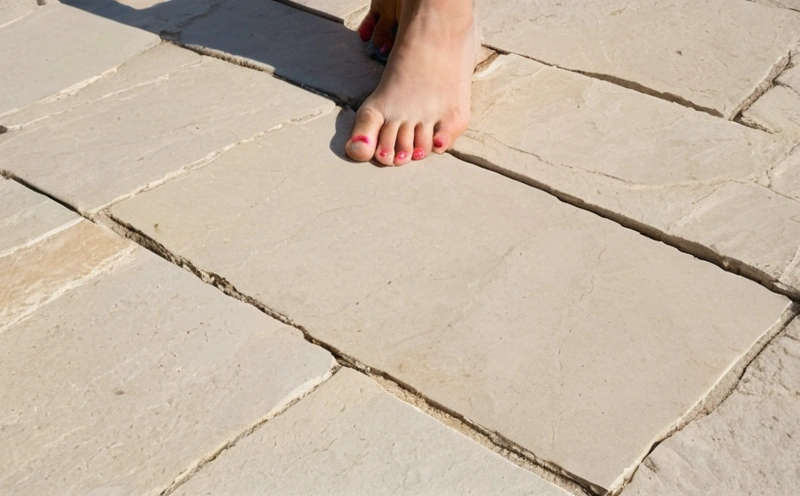
At what surface temperature does a bare foot stop coping?
Skin held against a 44 degree surface takes about six hours to sustain a burn, at 51 degrees the time falls to roughly three minutes, and at 60 degrees damage begins in under five seconds. A walking step lasts 0.5 to 1 second per foot on a July terrace, which sets the practical thresholds.
A 60 degree surface is crossable at a fast walk and a 70 degree surface is not crossable at all. Any position where people stand still, a barbecue station or a pool edge or a step landing, needs to hold below 50 degrees from 12:00 to 17:00 in July. Children and dogs run to a lower limit again: paw pads blister at 55 degrees, and only pale limestone, white marble and pale porcelain stay under 55 degrees in unshaded July sun.
How much does light reflectance value lower a slab temperature in July?
Light reflectance value runs from 0 for black to 100 for white, and on Gulf terraces every 10 point rise in LRV lowers the 15:00 July surface temperature by 2 to 3 degrees. Moving from an LRV 18 charcoal to an LRV 58 sand takes roughly 10 degrees off the slab in that hour.
Pale paving has a ceiling. Above LRV 70 a terrace throws back enough light at 11:00 in June to force people to squint, and reading outdoors becomes tiring within a few minutes. A bright white terrace also lights the underside of a pergola, which then radiates downward and cancels part of what the pale slab saved. LRV 45 to 60 keeps the surface under 60 degrees at 15:00 in July without turning the terrace into a reflector.
Why does a 60 mm sandstone terrace still read 41 degrees at 21:00?
A 60 mm sandstone slab bedded on sand stores enough heat through a July day to measure 41 degrees at 21:00 while the air has fallen to 34 degrees. A 20 mm porcelain slab on adjustable pedestals, with a ventilated cavity beneath, measures about 35 degrees at the same hour on the same evening.
| Build-up | Slab thickness | 15:00 in July | 21:00 in July, air at 34 degrees | Usable for an evening barefoot |
|---|---|---|---|---|
| Sandstone bedded on sand | 60 mm | 62 to 68 degrees | 41 degrees | no |
| Concrete paver on mortar bed | 50 mm | 58 to 63 degrees | 39 degrees | marginal |
| Porcelain bonded to a screed | 20 mm | 70 to 76 degrees | 38 degrees | marginal |
| Porcelain on pedestals, cavity closed | 20 mm | 70 to 76 degrees | 37 degrees | marginal |
| Porcelain on pedestals, cavity vented at the perimeter | 20 mm | 70 to 76 degrees | 35 degrees | yes |
| Thermally modified timber on joists | 21 mm | 55 to 61 degrees | 34 degrees | yes |
A pedestal build-up runs in four layers: waterproofing, drainage layer, pedestals from 40 mm to 150 mm to take up the fall, then 20 mm porcelain. The cavity also carries drainage, which matters during the two or three heavy rain events a UAE winter produces against a long term average near 90 mm of rain a year on the coast.
Which slip rating, absorption and joint width suit a Gulf terrace?
Pool surrounds and irrigation overspray zones on a UAE terrace need slip rating R11 or a wet pendulum value above 36, porcelain absorption below 0.5 per cent, and open joints of 3 to 5 mm. A 3 m porcelain run expands about 1.2 mm between 15 degrees in January and 74 degrees in July.
- Water absorption below 0.5 per cent for porcelain. Natural limestone at 3 to 6 per cent absorption draws salts from the bedding and from coastal air, then shows white efflorescence across the surface within two summers.
- Open joints of 3 to 5 mm on pedestal systems. A rigid narrow joint transfers the 1.2 mm of summer movement in a 3 m run into the slab edges, and porcelain chips at the arris rather than lifting.
- Grade 316 stainless steel for every fixing within 2 km of the coast. Grade 304 shows rust bleeding at the fixings within a single coastal season.
- Fresh water rinse every month within 2 km of the coast, to keep salt crystals out of the surface texture.
- Falls of 1 in 80 to a channel or a perimeter cavity, since a UAE winter delivers most of its 90 mm of rain in two or three events rather than evenly.
Does shade beat material choice on a July terrace?
Dark grey porcelain that measures 74 degrees in open sun at 15:00 in July measures about 44 degrees under a slat roof at 78 per cent cover. Shade moves a paving material two rows up the temperature table, while changing the material alone moves a slab one row.
Terraces with a fixed roof can therefore use the dark tone many owners prefer, and terraces without a roof are limited to the pale end of the table. Slat width, gap and the cover each combination produces are set out in the note on pergola shade angles.
For an unshaded terrace intended for bare feet, the safe specification is 20 mm porcelain at LRV 50 to 58, laid on vented pedestals, R11 finish, 4 mm open joints. That build-up measures about 56 degrees at 15:00 in July and about 34 degrees at 21:00, which covers most of what a Gulf terrace is asked to do between May and September.