Planting
Which terrace plants survive a Gulf summer in pots
Air temperature gets the blame every August, and the root zone does the killing. Soil inside a 30 litre black plastic pot standing on dark paving reaches 48 to 52 degrees by 15:00 in July. Root hairs on most ornamental shrubs stop functioning above 40 degrees and die after a few hours above 45 degrees. The same shrub planted in open ground survives the same afternoon, because soil 300 mm below grade holds near 34 degrees.
How do you hold a pot root zone below 40 degrees in July?
Volume carries the root zone. A 60 litre pot runs 4 to 6 degrees cooler at 15:00 in July than a 30 litre pot, a pale fibre clay pot with a 25 mm wall runs 6 to 8 degrees below black plastic of matched volume, and stacking three measures below brings a July root zone under 40 degrees.
| Measure | Root zone effect at 15:00 in July | Cost order | Worth doing on its own |
|---|---|---|---|
| 30 litre black plastic pot on dark paving (baseline) | 48 to 52 degrees | lowest | baseline |
| Increase pot volume from 30 to 60 litres | 4 to 6 degrees lower | low | yes |
| Increase pot volume from 60 to 150 litres | a further 3 to 5 degrees lower | medium | yes, for trees |
| Pale fibre clay, 25 mm wall, same volume | 6 to 8 degrees lower | medium | yes |
| Double potting with a 30 mm air gap | 3 to 4 degrees lower | low | only with a pale outer pot |
| 50 mm of 20 mm washed gravel mulch | about 5 degrees lower at the soil surface, evaporation down by a third | lowest | yes |
| Pot feet lifting the base 25 mm clear | removes conduction from paving at 70 degrees | lowest | yes |
| Grouping five pots in a block | 2 to 3 degrees lower in the middle pots | none | yes |
| 50 per cent shade cloth, 1 June to 15 September | leaf temperature 4 to 6 degrees lower | low | yes |
Pot feet matter more than the price suggests. Dark porcelain measuring 70 degrees at 15:00 in July conducts straight into a pot base sitting flat on the slab, and a 25 mm air gap breaks that path for the cost of eight rubber pads. No measure in the table substitutes for volume, because soil mass is the only real thermal buffer a container has.
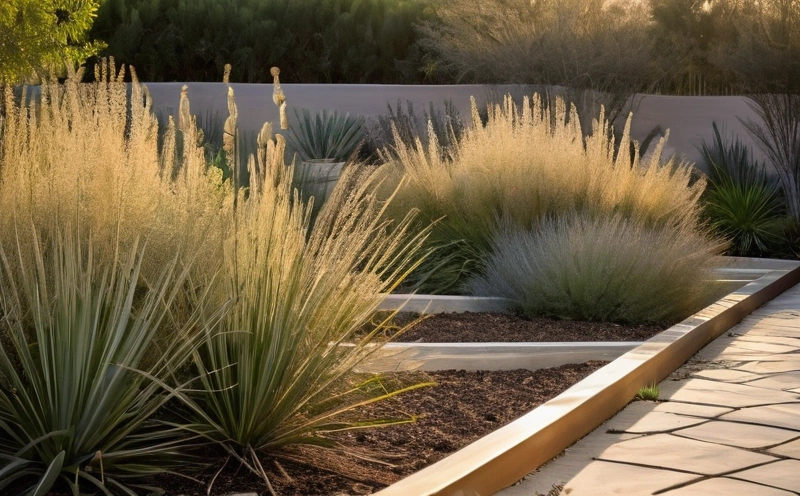
Which species hold through August on an exposed UAE terrace?
The reliable list for an exposed UAE terrace runs to about a dozen species, and every plant on the list tolerates both 45 degree air at 15:00 in July and the 27 to 29 degree dew points that arrive on the coast in August. Humidity kills more terrace planting in the Gulf than heat does.
- Bougainvillea glabra: full sun, flowers from March to November, high water demand, needs a pot of 100 litres or more to hold a mature plant through July.
- Plumeria obtusa: thick stems store water, tolerates air at 48 degrees, moderate water demand, drops leaves in January and recovers in March.
- Carissa macrocarpa: dense evergreen hedging to 1.5 m, salt tolerant, moderate water demand, reliable within 500 m of the coast.
- Tecoma stans: yellow flowering shrub to 2 m, the thirstiest plant on the list, and the first to wilt after a missed cycle in July.
- Nerium oleander: tolerates 48 degree air and saline water, though every part of the plant is toxic, so keep Nerium oleander away from terraces used by small children.
- Portulacaria afra, Agave attenuata, Aloe vera and Euphorbia tirucalli: four succulents at the lowest water demand on the list, and none of the four minds a missed cycle in July.
- Dracaena trifasciata, long sold as Sansevieria: tolerates shade and neglect, useful against a north wall that receives no direct sun between October and March.
- Russelia equisetiformis: trailing habit that softens a pot rim, moderate water demand, cut back hard in late February.
- Pennisetum setaceum and Muehlenbeckia complexa: movement and texture at low water demand, both cut to 100 mm in February.
Four groups fail predictably on Gulf terraces. Lavender and rosemary rot at the crown once August dew points pass 27 degrees, boxwood scorches at the leaf margin above 42 degrees, hydrangea collapses within a fortnight of the first 42 degree day, and Ficus benjamina in a pot drops most of a canopy after any irrigation gap longer than 24 hours in July. Nurseries across Dubai sell all four in April.
How many litres per week does each pot size need in July?
A 60 litre pot carrying a woody shrub uses 3 to 5 litres a day in July, which comes to 21 to 35 litres a week, and 7 to 12 litres a week in January. Irrigation controllers are set in minutes while plants consume litres, so convert once at commissioning and the guesswork stops.
| Pot volume | Suits | Litres per week, July | Litres per week, January | Dripper setup, two cycles a day |
|---|---|---|---|---|
| 18 litres | succulent, small grass | 4 to 7 | 1 to 2 | one 2 litre per hour dripper, 12 minutes |
| 40 litres | Russelia, small Carissa | 14 to 21 | 5 to 7 | two 2 litre per hour drippers, 18 minutes |
| 60 litres | woody shrub to 1.5 m | 21 to 35 | 7 to 12 | two 4 litre per hour drippers, 15 minutes |
| 100 litres | Bougainvillea, Plumeria | 35 to 56 | 12 to 19 | three 4 litre per hour drippers, 18 minutes |
| 150 litres | small tree to 3 m | 56 to 84 | 19 to 28 | four 4 litre per hour drippers, 20 minutes |
Timing carries as much weight as volume. Run the first cycle at 04:30 and the second at 19:00 through July and August. Surface irrigation applied between 11:00 and 16:00 in July loses 40 to 60 per cent of the water to evaporation and wets leaves at the hour when wet leaves scorch. Set the controller once for the summer programme in late April and once for the winter programme in late October rather than adjusting week by week.
How much salt does UAE irrigation water carry, and what substrate handles it?
Municipal water in Dubai and Abu Dhabi is largely desalinated and runs 120 to 250 ppm total dissolved solids, which suits container planting. Tanker or well water at 1500 to 3000 ppm burns leaf margins within about three weeks of daily July irrigation, starting on Bougainvillea and Tecoma stans.
Salts concentrate inside any pot, whatever the source, because every litre applied evaporates and leaves the minerals behind. Apply one long leaching cycle each month, roughly 20 per cent more water than the pot volume in a single run, and confirm the drainage holes still run freely afterwards. A 60 litre pot therefore takes a 72 litre flush, which at two 4 litre per hour drippers would take 9 hours, so a hand held hose does the monthly leach faster than the drip line can.
A substrate that survives daily irrigation at 45 degrees needs structure: 50 per cent sandy loam, 30 per cent composted organic matter, 20 per cent 6 mm pumice or perlite. Pure coir or peat dries to a hard block by the second week of July, and water then runs down the gap between block and pot wall without wetting any roots. Rewetting a collapsed coir block takes a 30 minute soak in a bucket, which is not a maintenance task anyone repeats.
When should terrace pots be fed, and when should feeding stop?
Feed with a controlled release 14-14-14 at 4 g per litre of substrate in late February and again in late September, and stop feeding entirely between 1 June and 31 August. Growth forced in July carries soft tissue that burns within days once leaf temperature passes 45 degrees at 14:00.
A 60 litre pot therefore takes 240 g of controlled release feed per application, 480 g across the two applications in a year. Shade cloth at 50 per cent from 1 June to 15 September lowers leaf temperature by 4 to 6 degrees at 14:00 in July and costs less than replacing the planting in October. Paving under the pots feeds heat upward all afternoon, and surface temperatures by material sit in the note on terrace paving and heat.