Lighting
How much light a terrace needs after dark, and at what colour temperature
Updated:
A Gulf terrace earns most of its use between 19:00 and midnight from October to May, and the lighting installed on most terraces is borrowed from a car park. A single 1500 lumen floodlight throws roughly 750 lux across a small terrace, which is supermarket aisle brightness. Correct levels sit far lower than any specification sheet suggests.
How many lux does each part of a terrace need after dark?
Circulation across a terrace needs 5 to 20 lux, steps need 20 to 30 lux with the source held below eye height, and a dining table needs 50 to 100 lux on the surface. Six sources at 120 to 200 lumens each produce a usable outdoor room, while one bright source produces a stage.
| Area | Target illuminance | Fixture type | Lumens per fixture | Colour temperature |
|---|---|---|---|---|
| Circulation across paving | 5 to 20 lux | shielded bollard below 400 mm | 80 to 150 | 2200K to 2700K |
| Steps and level changes | 20 to 30 lux | recessed louvred step light | 60 to 120 | 2700K |
| Dining table surface | 50 to 100 lux | pendant or three narrow downlights | 200 to 400 in total | 2700K |
| Food preparation counter | 150 to 300 lux | shielded strip under the upstand | 400 to 700 | 3000K |
| Planting and wall wash | 3 to 10 lux vertical | shielded uplight, 15 degree beam | 120 to 200 | 2200K |
| Pool water | 30 to 60 lux | submerged niche fitting | 400 to 900 | 2700K |
| Supermarket aisle, for comparison | 750 lux | linear ceiling array | 4000 and above | 4000K |
Position beats output. Light aimed at a surface, a wall or a planter or a step nosing, reflects back at low intensity and reads as ambient light. Light aimed at people creates glare and forces the pupil to close, which makes the rest of the terrace look darker than a meter reading of the same scene says.
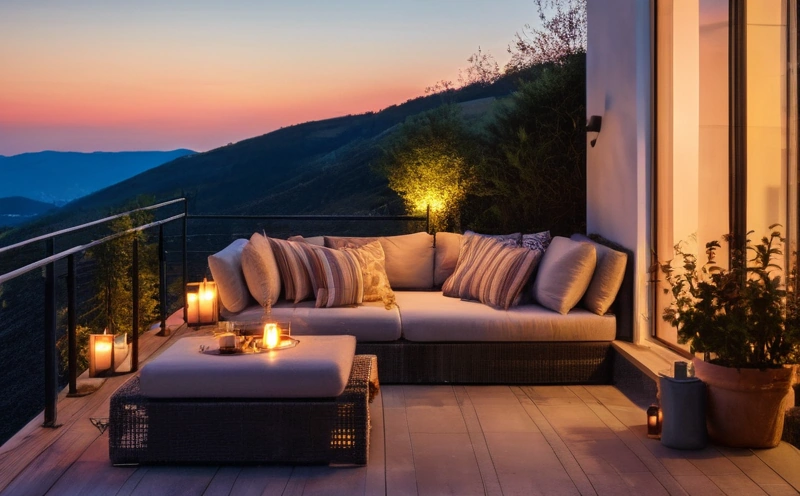
Which colour temperature attracts the fewest insects on a Gulf terrace?
Flying insects orient toward short wavelengths, with the response peaking between 350 and 500 nanometres. A 4000K LED carries a strong blue peak near 450 nm and sits inside that band, while a 2200K amber LED emits very little below 500 nm. Field comparisons of lamp types report 40 to 60 per cent fewer insects at amber sources.
| Lamp | Colour temperature | Output below 500 nm | Reported insect catch against a 4000K LED of matched lumens | Use on a terrace |
|---|---|---|---|---|
| Amber LED | 1800K to 2200K | negligible | 40 to 60 per cent lower | planting, wall wash, paths |
| Warm white LED | 2700K | small blue peak near 450 nm | 20 to 35 per cent lower | dining, steps |
| Neutral white LED | 3000K | moderate blue peak | 10 to 20 per cent lower | food preparation only |
| Neutral white LED | 4000K | strong blue peak | baseline | not outdoors |
| Cool white LED | 5000K to 6500K | strong blue peak | higher | not outdoors |
| Mercury vapour or metal halide | 4000K and above | strong, plus output below 400 nm | several times higher | not outdoors |
The catch figures above are reported ranges from field comparisons of lamp types, not a single controlled study, so treat the column as an ordering rather than as precise values. The ordering is consistent across the comparisons: catch falls as the share of output below 500 nm falls.
Mosquitoes require a separate response from other flying insects. Mosquito species track exhaled carbon dioxide, body heat and skin odour rather than light. Amber lamps therefore cut moths and midges without changing the mosquito count on a terrace. Anyone selling a lamp as a mosquito solution is selling the wrong product. A colour rendering index of 90 or above keeps planting and timber looking correct at 2200K to 2700K, while a low index turns green foliage grey. Planting choices for the terrace are covered in Gulf summer plants in pots.
How low must a fixture sit before it stops glaring at seated eye height?
Seated eye height on a terrace measures about 1.15 m and standing eye height about 1.6 m. Every source should sit below 400 mm or hide behind a shield, so that no LED is directly visible from either height. A bare LED strip under a bench is comfortable, and the same strip on a wall at 1.3 m is not.
Bollards need a top cap and a side lens rather than a diffuser that glows in every direction. Step lights need a recessed louvre set back at least 20 mm from the face. Uplighting a palm shows the difference a beam angle makes: a 3 to 6 watt uplight with a 15 degree beam, set 800 mm out from the trunk, puts light on the trunk and the crown underside and almost nothing past the canopy, while a 60 degree flood in the same position lights the tree, the sky and the neighbouring terrace.
What light spill is allowed at a neighbouring window after 23:00?
CIE 150 sets vertical illuminance at a neighbouring window to 10 lux in environmental zone E3, suburban, and 25 lux in zone E4, urban centre, before curfew. After 23:00 the same limits fall to 2 lux in E3 and 5 lux in E4. Most Gulf villa compounds sit in E3.
A phone lux meter held flat against the boundary wall gives a reading good enough for a domestic terrace, and anything above 5 lux at the boundary after 23:00 is a complaint waiting to be made. Specify an upward light output ratio of zero for every fitting mounted above ground level, which rules out the open topped bollard sold in most Dubai lighting showrooms.
Which fixture specification survives Gulf heat, salt and dust?
A sealed fixture on a west facing wall sits in 48 degree air at 20:00 in August, so the driver needs an ambient rating of 55 degrees or above. Fixtures within 2 km of the coast need IP66 and grade 316 stainless steel, because grade 304 shows rust bleeding at the fixings within one coastal season.
- Driver rated for an ambient of 55 degrees or above. A driver rated to 40 degrees fails inside one or two Gulf summers on a west facing wall.
- Remote drivers wherever the layout allows, mounted in a ventilated enclosure indoors, which turns a driver replacement into a five minute job.
- IP65 as the minimum, IP66 or IP67 within 2 km of the coast or anywhere within 3 m of a pool edge.
- Grade 316 stainless steel for every visible fixing, and marine grade powder coating on aluminium bodies.
- Monthly fresh water rinse of bodies and lenses. Dust film cuts measured output by 20 to 30 per cent within three months on an unrinsed terrace, so a monthly wipe restores more light than any increase in lamp wattage.
What schedule suits sunset between 17:35 in December and 19:15 in June?
Sunset in the UAE swings between 17:35 in late December and 19:15 in late June, a spread of 100 minutes, so a fixed clock setting wastes an hour and a half of run time every winter evening. An astronomical timeclock tracks sunset through the year and needs no seasonal adjustment.
Run the full scheme from sunset to 23:00, then drop to step lights only at 20 per cent output until 06:00. Add a motion sensor with a 30 second hold on side paths, which keeps those routes dark for most of the night and lit whenever anyone walks them. A slatted roof holds warm light inside the terrace instead of letting the beam escape upward, which raises perceived brightness at the same wattage, and slat cover figures sit in the note on pergola shade angles.