Shade
Pergola slat spacing that shades a terrace at 13:00 in June
On 21 June the sun over Dubai, latitude 25.2 degrees north, reaches an altitude of 88 degrees at solar noon, which falls at 12:20 local time. By 13:00 on the same day the sun has dropped only to 81 degrees. A pergola designed for 13:00 in June is a pergola designed for a beam arriving almost straight down.
Slat geometry decides the outcome, not slat quantity. Two pergolas can carry the same tonnage of aluminium and shade 78 per cent and 27 per cent of the same deck at 13:00 in June, because one lays the slats flat and the other stands them on edge.
How much shade does a flat slat roof cast at 13:00 in June?
A flat slat, wide face parallel to the ground, casts a shadow the same width as the slat at every sun altitude, so shade cover at 13:00 in June equals slat width divided by pitch. A 140 mm slat at a 180 mm pitch covers 78 per cent of the deck.
Pitch means slat width plus gap. Widening the gap from 40 mm to 70 mm on a 140 mm slat drops cover from 78 per cent to 67 per cent, and each extra 10 mm of gap removes 3 to 4 percentage points. The ratio of slat depth to gap does nothing at this hour on a flat slat, because a horizontal strip projects its own width onto the floor whatever the sun altitude. A slat schedule drawn in millimetres beats a conversation about how open the roof should feel.
| Slat width | Gap | Pitch | Cover at 13:00 in June | Deck in sun, per 10 m2 |
|---|---|---|---|---|
| 140 mm flat | 30 mm | 170 mm | 82 per cent | 1.8 m2 |
| 140 mm flat | 40 mm | 180 mm | 78 per cent | 2.2 m2 |
| 140 mm flat | 50 mm | 190 mm | 74 per cent | 2.6 m2 |
| 140 mm flat | 70 mm | 210 mm | 67 per cent | 3.3 m2 |
| 140 mm flat | 90 mm | 230 mm | 61 per cent | 3.9 m2 |
| 90 mm flat | 30 mm | 120 mm | 75 per cent | 2.5 m2 |
| 190 mm flat | 50 mm | 240 mm | 79 per cent | 2.1 m2 |
| 140 mm on edge | 140 mm | 160 mm | 27 per cent | 7.3 m2 |
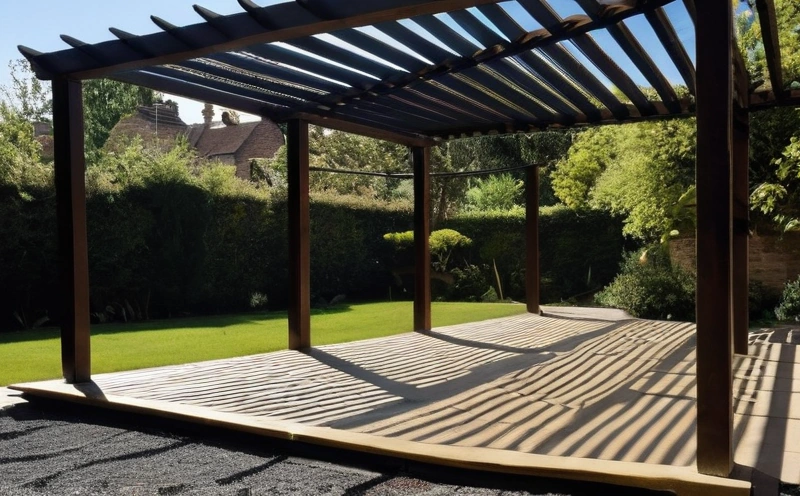
Why do fins on edge give only 27 per cent cover at 13:00 in June?
A 140 mm deep fin standing on edge throws a 43 mm shadow at 13:00 in June, because 140 divided by the tangent of 81 degrees comes to 23 mm and the fin adds its own 20 mm thickness. At a 160 mm pitch, cover reaches 27 per cent of the deck.
Terraces built with deep fins on edge photograph well and sit unusable between 11:00 and 14:00 through June, July and August. A 200 mm fin at the same 160 mm pitch raises cover at 13:00 in June only to 33 per cent, so depth does not rescue the arrangement. Depth to spacing ratio governs the result: a fin needs a depth to gap ratio above 6 to 1 before it closes at 81 degrees, and a 140 mm fin at a 20 mm gap is a solid roof with extra weight.
Fins earn their place after 15:00. The June sun sits at 54 degrees at 15:00, 40 degrees at 16:00 and 34 degrees at 16:30, and a 140 mm fin throws shadows of 123 mm, 185 mm and 230 mm at those three hours. At a 160 mm pitch the fin array closes completely by 16:00 in June. Fins running north to south block the low western sun after 16:00. Fins running east to west contribute almost nothing at that hour, because the shadow travels along the run rather than across the gaps.
How far does the shadow pattern shift between 09:00 and 17:00 in June?
The shadow pattern under a pergola slides sideways by roof height divided by the tangent of the sun altitude. A roof 2.8 m above the floor shifts its pattern 0.45 m at 13:00 in June, 2.05 m at 15:00 and 5.48 m at 17:00, when the June sun sits 27 degrees above the horizon.
| Hour, 21 June, Dubai | Sun altitude | Sun azimuth | Pattern shift, roof at 2.8 m | Cover under a 140 mm slat at 180 mm pitch |
|---|---|---|---|---|
| 09:00 | 45 degrees | 81 degrees, east | 2.84 m | 78 per cent, eastern strip in full sun |
| 11:00 | 72 degrees | 91 degrees, east | 0.93 m | 78 per cent |
| 12:20 | 88 degrees | overhead | 0.09 m | 78 per cent |
| 13:00 | 81 degrees | 261 degrees, west | 0.45 m | 78 per cent |
| 15:00 | 54 degrees | 276 degrees, west | 2.05 m | 78 per cent, western strip losing cover |
| 17:00 | 27 degrees | 285 degrees, west | 5.48 m | side sun, the roof contributes nothing |
The pattern shift explains a common complaint. A pergola measuring 4 m across the east to west axis gives full protection at 12:20 in June and leaves half the seating in sun by 15:00, because 2.05 m of the shadow pattern has already walked off the western edge. A 1.8 m vertical screen on the west side fixes the hours after 15:00 in June, and no change to the slat spacing overhead will. Winter behaves differently again: the sun reaches only 41 degrees at solar noon on 21 December, so the same 2.8 m roof shifts its pattern 3.2 m at midday and a December lunch sits in sun by design.
How hot does a pergola ceiling get under June sun?
Aluminium slats in a dark powder coat measure 75 to 82 degrees Celsius under June sun at 14:00, and a ceiling at that temperature radiates downward onto a seated head 2.6 m below. A light grey or bone coat holds the same slat near 58 degrees at the same hour on the same day.
Thermally modified ash slats measure 55 to 60 degrees at 14:00 in June, because timber conducts poorly and sheds heat from a thin surface layer. Colour on the underside of the slat matters more than colour on the top face, since the underside is the surface a seated person sees, and most suppliers quote a single finish for both faces. People sitting in full shade under a dark ceiling report discomfort at 14:00 in June while no direct sun touches them.
Openness carries the same weight. A solid roof traps a layer of hot air against the underside through the afternoon. Keeping 20 to 25 per cent of the plan area open lets that layer rise away, and air temperature under a slatted roof typically runs 3 to 5 degrees below air under a solid roof of the same colour at 15:00 in July. A 140 mm slat at a 180 mm pitch leaves 22 per cent open, which sits inside that band without giving up midday cover.
What slat specification suits a Dubai terrace?
A fixed roof of 140 mm flat slats at a 180 mm pitch, 2.8 m clear height, pale on the underside, with a 1.8 m screen on the western boundary, covers 78 per cent of the deck at 13:00 in June and closes the low western sun after 16:00. The full schedule runs as follows.
- Clear height 2.8 m rather than 2.4 m, for airflow and to hold the hot ceiling further from a seated head.
- Flat slats 140 mm wide at a 40 mm gap, giving 78 per cent cover at 13:00 in June and 22 per cent open area.
- Pale finish on the underside, whatever colour the top face carries, worth about 20 degrees of ceiling temperature at 14:00 in June.
- A 1.8 m screen or north to south fins on the western boundary for the hours after 16:00 in June, once the sun drops below 40 degrees and arrives from the side.
- Adjustable louvres if the budget allows: flat at 13:00 in June, tilted to 70 degrees at 16:30. Adjustable aluminium systems cost three to five times a fixed timber roof per square metre.
Shade geometry also sets the paving budget. Dark grey porcelain measuring 74 degrees in full sun at 15:00 in July measures about 44 degrees under a roof at 78 per cent cover, which moves the same material from unusable to barefoot. Surface temperatures by material sit in the note on terrace paving and heat.